


Thoughts on God’s Sukkah of Peace
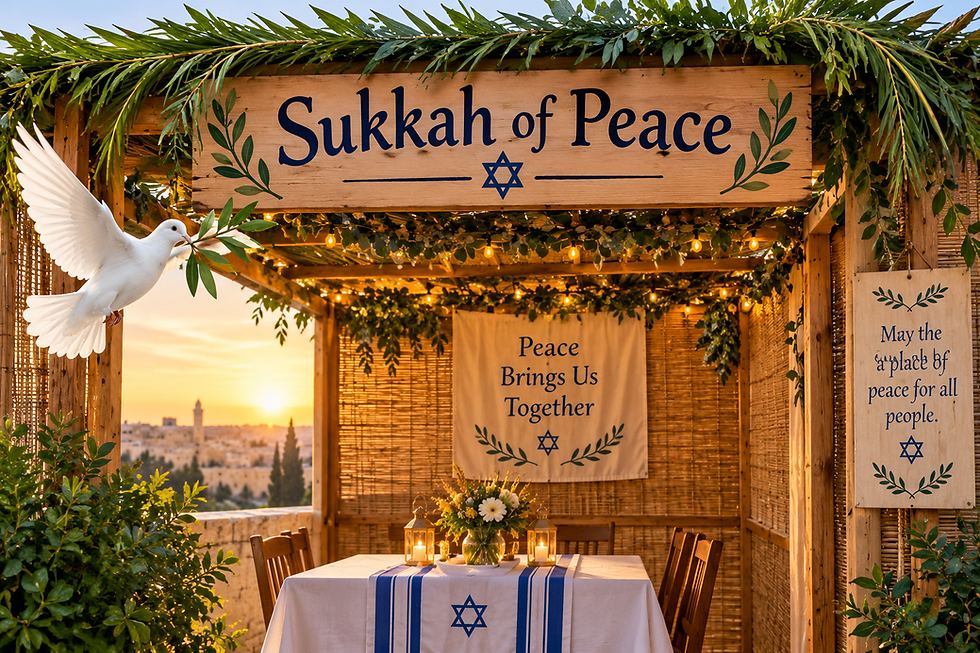
We continue this weekend with our fall holiday season. Rosh Hashanah and Yom Kippur have passed, and we pray that the hopes we carried into the new year will be fulfilled. It was wonderful to see so many of you at services, along with newcomers whom we hope will return. Our thanks go to Micah Fogel for leading portions of the service and organizing the honors, to Micah Kurtzman for his extraordinary shofar blowing — that final blast at Neilah surpassed even his past efforts — and to Jennifer Fogel for once again preparing a creative and delicious break-fast. We are grateful as well to all our volunteers. As we say in our Shabbat prayers, HaKadosh Baruch Hu y’shalem s’charam — may the Holy One reward your efforts, and we thank you. With this Shabbat, the mood shifts. We move from the solemn introspection of the High Holy Days — days of repentance, forgiveness, and muted joy — into the festival of Sukkot, a holiday the Torah calls a season of rejoicing not once, but three times. No other pilgrimage festival carries this title. Pesach celebrates liberation, Shavuot celebrates revelation, but Sukkot alone is Z’man Simchateinu, the season of our joy.
What, then, is the source of this joy? Pesach and Shavuot commemorate dramatic moments in our history. Sukkot’s historical origin is less obvious. If the holidays followed the sequence of events after the Exodus, one might expect the third festival to mark the arrival in the Promised Land. Instead, Sukkot celebrates the journey itself — the years of wandering, when God sheltered and guided us. As in life, the journey often shapes us more deeply than the destination. The central symbol of Sukkot is the sukkah. In ancient Israel, it was a simple harvest hut — boards or stones for walls, branches for a roof — a temporary shelter for workers gathering the crops. The Torah tells us that the sukkah is meant to remind us of the dwellings in which God “caused us to live” in the wilderness. Yet our ancestors lived in tents, not huts. The rabbis noticed this and reinterpreted “sukkot” as the ananei ha‑kavod, the clouds of glory that accompanied and protected the Israelites. The sukkah’s roof, the s’chach, symbolizes those clouds: material that grows from the earth but is no longer attached, providing more shade than sun, yet open enough that rain can still fall through. The sukkah must be sturdy enough to withstand a normal wind, but never so permanent that it could survive a storm. It is intentionally fragile — a reminder of our dependence on God. After Moses returned with the second tablets, he instructed the people to build another structure: the ohel moed, the Tent of Meeting. God promised to dwell not in the tent, but among the people. Later, the Mishkan accompanied Israel through the wilderness, and centuries afterward Solomon built the Temple in Jerusalem, dedicated during this very season. Solomon taught that wherever Jews lived, they should direct their prayers toward this house, and God would hear them. To this day, we pray toward Jerusalem, and the sukkah remains a symbol of God’s presence and protecting care.
The sukkah appears not only in our history but in our prayers. Each evening, after the Sh’ma, we recite Hashkiveinu, asking God to “cause us to lie down in peace and rise up again in peace.” On weekdays, we conclude by praising God as the One “who guards His people Israel forever.” But on Shabbat and festivals, the ending changes: Ufros aleinu Sukkat shlomecha — “Spread over us Your Sukkah of peace.” The blessing continues: “over us, over all Your people Israel, and over Jerusalem.” Why did our sages choose this variation? On the Shabbat of Sukkot, the words take on special resonance. The Kabbalists deepen this connection. The Zohar teaches that when Shabbat enters, a canopy of peace — Sukkat Shalom — spreads over the world. On Shabbat, forces of impurity are hidden away, and the world enjoys supernal shelter. Shabbat itself becomes a sukkah, enveloping us in holiness. The Zohar adds that this canopy bestows upon us the neshamah y’teirah, the additional Shabbat soul that heightens our experience of rest and sanctity.
Shabbat and Sukkot are unique mitzvot in that we can enter them fully. We do not merely speak about the sukkot of our ancestors; we step inside our own. We sit beneath a roof that represents the clouds of glory, open to the sky, vulnerable yet protected. Like Shabbat, the sukkah offers a foretaste of the world to come — me’ein olam haba. We pray for the day that will be “entirely Shabbat and rest,” and as we leave the sukkah at the festival’s end, tradition imagines that we may one day enter the sukkah of the Leviathan, where the righteous sit at God’s table.
The image of the sukkah — fragile yet sheltering, temporary yet sacred — speaks to our deepest aspirations for a world perfected under God’s sovereignty. Each week, Shabbat invites us into a vision of peace and harmony. On this Shabbat of Sukkot, that vision expands. We enter God’s Sukkat Shalom, connecting with God, with nature, and with our hopes for a better world — a world of joy, prosperity, and peace.
May the sukkah we build this year inspire us to build lives and communities worthy of God’s sheltering presence. And may God indeed spread over us, over all Israel, and over all humanity, a Sukkah of peace.
Shabbat shalom v’Chag Sameach!


Comments